
Marriage Visa USA: How to Bring Your Foreign Spouse to America
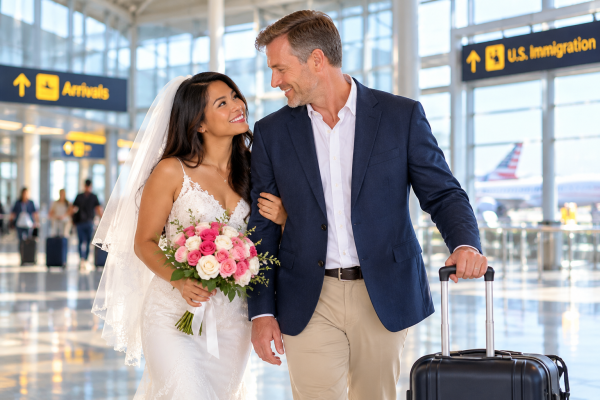
A marriage visa USA application allows the foreign-born husband or wife of a U.S. citizen to pursue permanent residence in the United States. If you are already married and want to live together in America, the usual consular immigration route is the CR-1 or IR-1 spouse immigrant visa.
The process starts with a marriage petition filed with U.S. Citizenship and Immigration Services (USCIS), continues through the National Visa Center (NVC), and normally concludes with an interview at a U.S. embassy or consulate abroad. Knowing what to expect can help you organize your records and avoid unnecessary delays.
Filipina Fiancée Visa Service has helped couples prepare immigration petitions for more than 25 years, with particular experience involving the Philippines. This guide explains the general marriage visa process for U.S. citizens bringing spouses from other countries to America.
What Is a Marriage Visa for the USA?
“Marriage visa” is a commonly used term rather than the name of one specific visa category. For a U.S. citizen sponsoring a spouse who lives abroad, the two principal immigrant visa classifications are CR-1 and IR-1. Both are based on a legally valid marriage and lead to lawful permanent residence upon admission to the United States.
A couple that is not yet married may instead wish to consider the K-1 fiancée visa process, if eligible. The distinction matters: a K-1 visa involves marrying after arrival, while a CR-1 or IR-1 marriage visa is for an existing marriage.
CR-1 vs. IR-1: Which Marriage Visa Applies?
The classification generally depends on how long the marriage has existed when the immigrant spouse enters the United States:
- CR-1 (conditional resident): The marriage is less than two years old when the spouse is admitted. The spouse receives conditional permanent resident status, ordinarily valid for two years.
- IR-1 (immediate relative): The marriage is at least two years old when the spouse is admitted. The spouse becomes a permanent resident without the marriage-based two-year conditions.
A CR-1 resident normally needs to file to remove conditions during the 90 days before conditional residence expires. FFV also offers Removal of Conditions petition preparation.
Marriage Visa USA Requirements
For a U.S. citizen petitioning for a foreign spouse, the basic requirements generally include:
- A legally valid marriage recognized for U.S. immigration purposes.
- Proof that any previous marriages have legally ended.
- Evidence that the marriage is genuine and not entered into solely for immigration purposes.
- An approved immigrant petition and successful completion of the immigrant visa application process.
- Required financial sponsorship, medical examination, civil records, and admissibility requirements.
Lawful permanent residents may also petition for spouses, but that follows a different preference-category process, not the CR-1/IR-1 immediate-relative process described here.
How to Apply for a Marriage Visa USA: Step by Step
Step 1: File Form I-130 for Your Spouse
The U.S. citizen typically files Form I-130, Petition for Alien Relative, along with the required spousal supplement, Form I-130A, and supporting evidence. You will document citizenship, the marriage, any termination of prior marriages, and the authenticity of your relationship. Consult the official USCIS Form I-130 instructions for current filing requirements.
Step 2: USCIS Reviews the Petition
USCIS reviews the evidence and may approve the petition, issue a request for evidence, or make another decision. Petition approval confirms the qualifying relationship for the next stage; it does not itself issue an immigrant visa.
Step 3: Complete National Visa Center Processing
After an approved petition reaches the NVC, the couple generally pays the applicable fees, completes the DS-260 immigrant visa application, submits the Affidavit of Support, and uploads required civil and financial documents. NVC may request corrections before determining that the case is documentarily complete. Read the State Department’s spouse immigrant visa overview for official process details.
Step 4: Complete the Medical Examination and Visa Interview
Once an appointment is available, the foreign spouse follows the embassy or consulate’s instructions for an examination by an authorized panel physician, required vaccinations, original records, and the interview. The interviewing officer evaluates eligibility and may request additional information or administrative processing.
Step 5: Receive the Visa and Enter the United States
If the visa is issued, review its expiration date and other details before making final travel arrangements. Upon admission with a CR-1 or IR-1 immigrant visa, the spouse becomes a lawful permanent resident. The physical green card is normally produced and delivered separately.
What Documents Are Needed for a Marriage Visa?
The exact list changes by case and by processing stage. Common documents include:
- Proof of the petitioner’s U.S. citizenship.
- A marriage certificate and proof any prior marriages ended.
- Evidence of the couple’s bona fide marital relationship.
- Birth certificates, valid passport, required police certificates, and any translations.
- Form I-864 and supporting financial records.
- Medical and interview documents required by the designated embassy or consulate.
For a more detailed introduction, see our spouse visa required documents guide. Applicants in the Philippines should pay particular attention to Philippine Statistics Authority records and National Bureau of Investigation clearance requirements.
Financial Sponsorship and Form I-864
Most petitioners must submit Form I-864, Affidavit of Support. The applicable income requirement is generally 125% of the federal poverty guidelines for the household size, with a special 100% rule for certain active-duty military sponsors petitioning for a spouse. Qualifying assets or a joint sponsor may help in appropriate cases, but the petitioner must also meet the U.S. domicile requirement.
Our immigration sponsorship income requirements article provides additional background. Always use the current guidelines and the instructions applicable to your case.
A Major Advantage: No Adjustment of Status After Arrival
One of the biggest practical benefits of the CR-1/IR-1 marriage visa is that the spouse becomes a permanent resident upon admission. Unlike a person who enters on a K-1 fiancée visa and marries afterward, the CR-1/IR-1 spouse generally does not need to file a separate Adjustment of Status application to obtain permanent residence.
This can mean fewer filings and less paperwork after arrival. On the other hand, couples who are not yet married may prefer to marry in the United States. Our fiancée visa versus spouse visa comparison explains how the two approaches differ.
How Long Does a Marriage Visa Take?
Marriage visa timing depends on USCIS petition processing, NVC document review, interview availability at the particular embassy or consulate, and case-specific delays. Processing estimates change, and an approved I-130 does not mean the visa interview is imminent. Couples should plan around current official information instead of relying on a guaranteed arrival date.
Can My Spouse’s Children Immigrate Too?
Children do not automatically receive immigrant visas as derivatives of a parent’s immediate-relative CR-1 or IR-1 petition. A U.S. citizen may need to file a separate qualifying petition for each child. When petitioning for a stepchild, the marriage creating the step-relationship generally must have occurred before the child’s 18th birthday. Tell your preparer about any children before the petitions are filed.
Frequently Asked Questions About the Marriage Visa USA Process
Do we have to get married before filing?
Yes. A CR-1 or IR-1 petition requires a qualifying legal marriage. Unmarried couples should consider whether a K-1 fiancée visa fits their circumstances instead.
Does my spouse receive a green card at the airport?
No. The spouse acquires permanent resident status upon admission with the immigrant visa, while the physical green card is ordinarily delivered afterward.
Can we use a joint financial sponsor?
A qualifying joint sponsor may be possible when the petitioner’s financial evidence is insufficient. The petitioner ordinarily must still submit the required affidavit and independently satisfy any applicable domicile requirement.
Is the process different for a spouse from the Philippines?
The major USCIS and NVC stages are similar, but civil documents and embassy instructions are country-specific. Our CR-1 Visa Philippines guide covers the process with special attention to Philippine applicants.
Get Experienced Help Preparing Your Marriage Visa Petition
Even when a couple is capable of completing the forms independently, gathering evidence, checking answers, organizing documents, and keeping track of each stage takes time. Filipina Fiancée Visa Service offers experienced document preparation and personal guidance so you can concentrate on your plans together.
We prepare your petition package and explain what documents and signatures you need to provide. You review, sign, and submit your paperwork according to our instructions. We can also assist with later stages as your case proceeds. Government agencies—not a preparation service—make all petition and visa decisions.
Ready to begin? Visit our CR-1 and IR-1 Marriage Visa Service page to learn about our preparation service and start your order. Current service pricing is provided through the ordering process.
You can also call 702-426-4503, Monday through Friday, 9 AM–5 PM Pacific Time (closed for lunch noon–1 PM).